Carolina Rig: Leader Length, Weight Size and Bead Setup
Dockrig is reader-supported. When you buy through links on this page, we may earn a commission.
A Carolina rig puts a sliding weight ahead of a leader. In order: weight, bead, barrel swivel, then an 18 to 48 in. leader to the hook. Start with a 3/4 oz weight and a 24 in. leader.
It covers flats and points fast and keeps the bait just off the bottom. In thick cover, it hangs up. Use a Texas rig there.
Spec card
Carolina rig
- Hook type & size
- offset or EWG worm hook, 1/0 to 5/0 by bait size
- Weight type & size
- egg, barrel or bullet weight, 1/2 to 1 oz; 3/8 oz for a light "split shot" version
- Leader length
- 18 to 48 in.; 24 in. to start
- Knot used
- Palomar or uni to the swivel and the hook
- Line
- 15 to 20 lb main line; leader 10 to 15 lb fluoro, lighter than the main line
- Water & cover
- flats, points, humps and ledges 6 to 25 ft; sand, gravel, shell, scattered grass
- Skip when
- thick grass, brush and laydowns
Rig it in 5 steps
Slide the weight onto the main line. Egg, barrel or bullet.
Step 1. Slide the weight onto the main line. Tap to enlarge. Add a bead. It protects the knot from the weight and adds a click.
Step 2. Add a bead. Tap to enlarge. Tie the main line to a barrel swivel. A Palomar on braid, a uni or clinch on mono.
Step 3. Tie the main line to a barrel swivel. Tap to enlarge. Tie the leader to the other eye of the swivel. Cut it to length first, 18 to 48 in.
Step 4. Tie the leader to the other eye of the swivel. Tap to enlarge. Tie on the hook and rig the bait Texas style. Point skin-hooked for weedless.
Step 5. Tie on the hook and rig the bait Texas style. Tap to enlarge.
The order matters. Weight, bead, swivel. If the bead goes on after the swivel knot, you'll retie.
The bead sits between the weight and the knot. A heavy weight banging on a knot all day can damage it. A glass or hard plastic bead takes the hits. Some anglers like the click it makes.
The swivel is the stop. It keeps the weight from sliding down onto the leader. See knots for swivels for the 3 common knots.
Leader length by bottom and grass
| Situation | Leader | Why |
|---|---|---|
| clean sand or gravel, active fish | 18 to 24 in. | more feel, easier casting |
| scattered grass 6 to 12 in. tall | 24 to 36 in. | bait rides over the grass |
| inactive fish, clear water | 36 to 48 in. | slower, more natural fall |
| floating bait over moss | 36 to 48 in. | bait floats up off the bottom |
A shorter leader casts easier and keeps the bait near the weight. A longer leader lets the bait drift and fall slowly behind it.
Longer leaders get hard to cast past about 4 ft. On a 7 ft rod, many anglers stop at about rod length.
Weight size
| Water | Weight |
|---|---|
| 6 to 12 ft, calm | 1/2 to 3/4 oz |
| 12 to 25 ft or wind | 3/4 to 1 oz |
| light version, shallow | 3/8 oz or split shot |
Heavier weights hold bottom and send more feel up the line. You can tell sand from gravel from shell. That's half the point of a Carolina rig. A pack of egg sinkers up to 1 oz covers the shallow and mid rows.
The light version uses a 3/8 oz weight or a large split shot. Some anglers call it a split shot rig. It's for shallow water and spinning gear.
The weight, bead and swivel are the parts you lose on snags. A Texas and Carolina rig kit keeps spares of all 3 in 1 box, plus a few hooks.
Carolina rig vs Texas rig
| Carolina rig | Texas rig | |
|---|---|---|
| Weight position | 18 to 48 in. ahead of the bait | against the bait or sliding just above |
| Cover | open bottom, scattered grass | grass, wood, docks |
| Coverage | fast, drag it across flats | slower, pitch to targets |
| Bait action | falls slowly behind the weight | falls with the weight |
| Weight | 1/2 to 1 oz | 1/8 to 1 1/2 oz |
Pick the Carolina rig to cover a big flat or point. Pick the Texas rig to fish cover target by target.
Fishing it
Cast long. Let the weight hit the bottom. Then drag it with the rod, sweeping from 9 to 11 o'clock.
Reel up the slack and repeat. The weight crawls along the bottom. The bait follows behind it.
When you feel the weight hit a rock or shell bed, slow down. Fish often hold where the bottom changes.
Bites often feel heavy, or the line just moves off to the side. Sweep the rod to set. A long leader means slack, so a sweep works better than a short snap.
Choosing the bait
- Lizards, 6 in.: a classic in spring.
- Creature baits, 4 in.: around shell and rock.
- Worms, 6 to 7 in.: all summer on flats.
- Floating worms: over moss, on a 36 to 48 in. leader.
Use a 2/0 or 3/0 hook for most of these. See soft plastic baits for rigging by type.
3 common variations
Standard. 3/4 to 1 oz weight, bead, swivel, 24 to 36 in. leader. Casting gear and 15 to 20 lb line.
Light, or split shot rig. A 3/8 oz weight or a big split shot pinched 18 to 24 in. above the hook. No swivel needed. Spinning gear and 8 to 10 lb line. Good for shallow, clear water.
Floating bait. A floating worm or lizard on a 36 to 48 in. leader. The bait rises off the bottom behind the weight. It's handy over short moss or grass that would swallow a sinking bait.
All 3 work the same way. Drag, pause, feel the bottom, then do it again.
Line choices
Main line is 15 to 20 lb. Fluoro sinks and gives feel. Braid of 30 to 50 lb gives even more feel and sweeps faster on a long leader.
The leader is lighter. 10 to 15 lb fluoro is common. If the leader snags, it breaks first. You keep the weight, bead and swivel.
Reading the bottom
A Carolina rig is a bottom-feel rig. The weight drags and taps, and the line carries that up to your hand.
- Sand: smooth and soft. The weight slides with little feel.
- Gravel: a steady tick-tick as the weight crosses it.
- Shell beds: a sharper crunch. Bass often hold on shell in summer.
- Rock: the weight bumps and catches. Lift a little and it pops free.
- Grass: a soft, sticky pull. Snap the rod to rip the weight through.
A heavier weight and braid main line make all of this easier to feel. With 1 oz on 40 lb braid, you can map a flat in a few casts. With 1/2 oz on mono, the signals are softer.
When you find a change, like sand turning to shell, make 5 or 6 casts across it. That edge is often where fish sit.
Seasons
Spring. Bass move up onto flats and points near spawning areas, often in 4 to 10 ft.
A lizard on a 24 in. leader with 1/2 oz is a common choice.
Summer. Fish move out to ledges, humps and deeper points, 12 to 25 ft. Go to 3/4 or 1 oz and a 30 in. leader.
Fall. Fish follow bait. A Carolina rig covers flats quickly while you look for them.
Winter. Slow everything down. A long leader and a small worm, dragged very slowly, can still work in 15 to 25 ft.
Rod and reel
A 7 ft to 7 ft 6 in. medium-heavy casting rod is common. The length helps on long casts and on the sweep hookset.
A reel with a 6:1 to 7:1 ratio picks up slack fast. With a 4 ft leader, there's a lot of slack to reel in before the set.
Spinning gear works for the light version. A 3/8 oz weight and 8 to 10 lb line casts well on a medium spinning rod.
Common mistakes
- Bead left off. The weight beats on the knot all day. Add the bead.
- Leader heavier than the main line. Then a snag breaks the main line, and you lose the whole rig. Go lighter on the leader.
- Leader too long to cast. Past 4 ft, casts get messy. Start at 24 in.
- Fishing it too fast. Drag, pause, drag. The bait needs time to settle.
- Short hookset. Sweep the rod to take up leader slack.
After a snag
Check the rig every time you pull free of a snag. The bead can crack. The swivel knot can fray.
Run the leader between 2 fingers. Rough spots mean a retie. A 24 in. leader takes about 1 minute to replace.
Where it fits on the water
- Spring flats in 4 to 8 ft: 1/2 oz, 24 in. leader, a 6 in. lizard on a 2/0.
- Summer points in 12 to 20 ft: 3/4 to 1 oz, 30 in. leader, a 7 in. worm on a 3/0.
- Ledges and humps in 15 to 25 ft: 1 oz, 24 to 36 in. leader, a creature bait.
- Clear water, light bites: 36 to 48 in. leader of 10 lb fluoro, a small worm on a 1/0.
When not to use a Carolina rig
- Heavy cover. The leader wraps branches. Use a Texas rig.
- Vertical fishing in deep water. A drop shot holds the bait in place.
- Shallow fish cruising high. A weightless wacky rig is quieter.
Common Questions
How long should a Carolina rig leader be?
Start at 24 in. Go to 18 in. on clean bottom with active fish. Go to 36 to 48 in. over grass or for slow, clear-water fish.
What weight for a Carolina rig?
3/4 oz is a common start. Use 1/2 oz in shallow, calm water and 1 oz deep or in wind.
Gear for this page
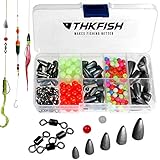 THKFISH Texas & Carolina Fishing Rig - Bullet-Weights, Sinkers, Hooks, Swivels, A Texas and Carolina kit with weights, beads and hooks for the Carolina rig.
 SANWEAL 40PCS Egg Sinkers Fishing Weights, 6 Sizes, 1/8-1oz Slip SinkersEgg sinkers from 1/8 to 1 oz for the Carolina rig.
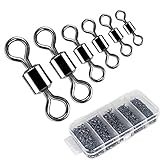 Siasky Fishing Swivels, 200pcs Barrel Swivels Fishing Stainless Steel Swivel FisBarrel swivels to stop the weight on a Carolina rig.
 Seaguar Invizx Freshwater 100% Fluorocarbon Fishing Line 12lbs, 200yds - 12VZ20012 lb fluoro for the Carolina rig leader.
Next rigs
- Fishing rigsevery rig on Dockrig compared
- Texas rigfor cover
- Wacky rigweightless, hooked in the middle
- Drop shot rigfinesse, hook above the weight
- Bass hooks by typeoffset and EWG
- Fishing weights by rigegg, barrel and bullet weights
Sources: common Carolina rig practice. Knot details from the linked knot pages. Method on our methodology page. Strike King, "How to Fish a Carolina Rig," for sinker, leader and hook.