Knots for Swivels: Palomar, Improved Clinch and Uni
Dockrig is reader-supported. When you buy through links on this page, we may earn a commission.
There's no single answer. Pick by line and by swivel.
- Braid to a barrel swivel: Palomar. The doubled line grips slick braid.
- Mono to a barrel swivel: improved clinch or uni. Both are quick and use about 6.5 in. of line per tie.
- Fluoro leader to a snap swivel: uni. The Palomar loop has to pass over the whole snap, which uses more line.
- Any line to a 3-way swivel: uni or Palomar on each of the 3 eyes.
The 3 knots differ in how they fit a swivel eye and which lines they suit.
Comparison matrix
| Knot | Mono | Fluoro | Braid | Barrel swivel | Snap swivel | Line per tie |
|---|---|---|---|---|---|---|
| Palomar | yes | yes | yes | easy | loop must clear the snap | 6.5 in. (1 in. swivel), 8.5 in. (2 in. snap) |
| Improved clinch | yes | yes, wet well | no, slips | easy | easy | 6.5 in. |
| Uni | yes | yes | yes, add turns | easy | easy | 6.5 in. |
Line per tie comes from our calculator. The assumptions are listed below the reties table. Each figure is the line a knot costs you when you cut it off and retie.
Palomar to a swivel
The Palomar doubles the line through the eye. Then you tie an overhand and pass the loop over the swivel. It's 5 steps, and it's the knot we'd tie for braid.
The doubled line is the point. 2 strands at the eye give braid more to grip. That's why it's a standard braid knot.
The cost shows up with snaps. The loop must pass over everything below the eye. A 1 in. barrel swivel is easy. A 2 in. snap swivel needs a bigger loop. On our numbers, that's about 2 in. more line per tie.
With a lure clipped to the snap, it's worse. You'd have to pass the loop over the lure too. Tie the knot first, then clip the lure on.
- Fits: braid main line to a barrel swivel on a Carolina rig or a drop shot.
- Watch: loop size on snaps and 3-way swivels.
- Line per tie: 6.5 in. on a 1 in. barrel swivel, 8.5 in. on a 2 in. snap swivel.
Improved clinch to a swivel
The improved clinch passes the line through the eye once. Then 5 to 7 turns around the standing line, back through the small loop, and through the big loop. It's quick and familiar.
It's a mono knot. On mono and fluoro tied wet, it seats well on a swivel eye. On braid, the turns can slide. We wouldn't tie it in braid.
Swivel eyes are smooth and round. That suits the clinch. The turns sit evenly on a round eye.
- Fits: mono main line to a stainless barrel swivel, 6 to 20 lb.
- Watch: heavy fluoro over about 20 lb. The turns get stiff and hard to close. Cut to 4 turns if they won't seat.
- Line per tie: about 6.5 in.
Uni to a swivel
The uni runs the line through the eye, then back alongside itself. You make a loop and wrap the tag inside it, 5 or 6 turns on mono. Then pull it down to the eye.
It works on all 3 line types. Braid needs a few extra turns. The uni also slides down onto the eye after it's tied, so it doesn't care how big the swivel is.
That makes it the easy pick for snap swivels and 3-way swivels. No loop to pass over anything.
- Fits: fluoro leader to a snap swivel; 3-way swivel rigs; braid with extra turns.
- Watch: wet it and pull the tag firmly before sliding it down.
- Line per tie: about 6.5 in.
Line used per tie and reties per leader
| Knot and swivel | Line per tie | Reties before a 36 in. leader drops under 18 in. | Reties for a 48 in. leader |
|---|---|---|---|
| Palomar, 1 in. barrel swivel | 6.5 in. | 2 | 4 |
| Palomar, 2 in. snap swivel | 8.5 in. | 2 | 3 |
| Uni, any swivel | 6.5 in. | 2 | 4 |
| Improved clinch, any swivel | 6.5 in. | 2 | 4 |
Our assumptions
- Tag to start: 6 in. on every knot.
- About 0.5 in. of line is used in the knot itself.
- Palomar loop: about 2 in. more to clear a 2 in. snap swivel.
- A leader shorter than 18 in. gets replaced, not retied.
These come from the same method as our Palomar line calculator. See the methodology page for how it's built.
What this means on the water: the knot choice changes line use only on snaps. On a barrel swivel, all 3 knots cost about the same. If you retie often on a Carolina rig, start with a 48 in. leader.
Snap swivels, 3-way swivels and braid
Snap swivels. Tie to the swivel eye, not the snap. The snap is for the lure. A uni is the simplest. A Palomar works if you tie it before clipping anything on.
3-way swivels. There are 3 eyes: main line, dropper to the hook, and dropper to the sinker. Tie a uni on each. Use lighter line on the sinker drop, so a snag breaks there first. Some anglers go 4 lb or so lighter.
Braid to a swivel. Palomar or a uni with extra turns. Skip the improved clinch. See knots for braided line for why.
Swivel below a slip bobber. Many slip bobber rigs use a small barrel swivel between main line and leader. It stops the weight sliding down. It also gives the bead and bobber something to rest on. See the bobber stop knot.
Where it fits on the water
- Carolina rig for bass on a 6 to 15 ft flat: 15 to 17 lb main line and a barrel swivel. Then an 18 to 48 in. fluoro leader. Palomar on braid, clinch or uni on mono.
- 3-way rig for river catfish: 20 to 30 lb mono. Uni on all 3 eyes. Sinker drop 12 in., hook drop 18 to 24 in.
- Inline spinner for trout: small snap swivel on 4 to 6 lb mono. Uni to the swivel eye.
- Panfish double rig: a dropper loop above the weight replaces a 3-way swivel. See the dropper loop.
Do you need a swivel at all?
Not always. A swivel adds a knot, so there are 2 knots to tie and check instead of 1.
Use one when line twist is a real problem. Inline spinners and some spoons spin the line. A swivel stops that twist from running up to the reel.
Use one when you need a stop. On a Carolina rig, the swivel keeps the weight off the leader.
Skip it on most soft plastics and jigs. Tie straight to the hook or jig with a Palomar and keep things simple.
Tying to small swivels
Small swivels have small eyes. A size 10 or 12 barrel swivel on a trout rig is hard to thread with a doubled line. That's where the Palomar gets fiddly.
On small eyes, the uni and clinch are easier. You pass a single strand through once. Cut the end at an angle first, so it threads cleanly.
Hold the swivel with pliers or hemostats while you tie. It's easier than pinching a 1/2 in. swivel with cold fingers. It also keeps the swivel from spinning while you wrap.
On a bigger 1/0 or 2/0 swivel for catfish, any of the 3 knots threads easily. Pick by line type then.
Checking the knot at the swivel
- Seated on the eye. The knot should sit snug against the eye, not halfway up the line.
- Turns even. No crossed or bunched turns on the clinch or uni.
- Tag trimmed. About 1/16 in. on mono, about 1/8 in. on braid.
- Pull test. Hold the swivel with pliers and pull the line for 2 or 3 seconds.
If the knot creeps up the line under the pull, it wasn't seated. Wet it and pull again, or retie.
Common mistakes
- Improved clinch in braid. Use a Palomar or uni.
- Palomar on a snap with the lure already clipped on. Tie first, clip after.
- Tying to the snap instead of the swivel eye. The snap end is for the lure.
- Dry fluoro. Wet every knot before you pull it down.
- Leader too short to retie. Start long, at 36 to 48 in., on rigs you retie often.
How to pick
- What's the main line? Braid: Palomar or uni with extra turns. Mono or fluoro: any of the 3.
- Barrel or snap? Snap: uni first. Barrel: whichever you tie fastest.
- How often do you retie? Often: a longer leader, 48 in. instead of 36 in.
- Heavy fluoro? Uni or Palomar. The clinch gets hard to close.
- 3-way swivel? Uni on each eye.
The same knots work on small stainless snap swivels like the #14 size. That size suits light spinners and spoons.
The swivel's own rating should be above your line test. That way the line or knot is the weak point, not the swivel. Sizes and ratings differ by brand. See swivels and snaps for how the numbers run.
Gear for this page
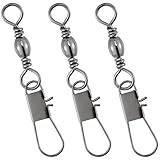 Dr.Fish 50 Pack Fishing Snap Swivels, Barrel Swivels Fishing Tackles, Stainless Snap swivels, tied on with the knots in knots for swivels.
 Siasky Fishing Swivels, 200pcs Barrel Swivels Fishing Stainless Steel Swivel FisStainless barrel swivels for a Palomar or improved clinch.
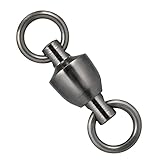 Dr.Fish 20 Pack Ball Bearing Fishing Swivels, Swivels Fishing Tackle Saltwater, Ball bearing swivels for line twist, see swivels and snaps.
 AMYSPORTS Duo Lock Snap Swivels - Stainless Barrel Swivels for Saltwater & FreshDuo lock snap swivels for quick lure changes, see swivels and snaps.
Read next
- Fishing knots by connectionevery knot on Dockrig by job
- Swivels and snapsbarrel, ball-bearing, 3-way and snap types
- Palomar knotthe 5 steps
- Uni knotturns by line
- Knot tying toolsclippers and pliers for retying
- Dropper loophooks above the weight without hardware
Sources: dockrig_calc.py swivel_line_use, the same method as our Palomar line calculator. Lefty Kreh and maker instructions on the linked knot pages. Method on our methodology page..