Fishing Swivels and Snaps: Barrel, Ball-Bearing, 3-Way and Snap Types
Dockrig is reader-supported. When you buy through links on this page, we may earn a commission.
Swivels and snaps sort by type and job. Barrel swivels stop twist and act as a stop. Ball-bearing swivels spin more freely. 3-way swivels put a hook and a sinker on separate drops. Snaps let you change lures fast.
We also cover slip bobber hardware here. It shares the same small-parts box and the same knots.
Types at a glance
| Type | Job | Common rigs | Size note |
|---|---|---|---|
| Barrel swivel | reduces line twist; a stop for a sliding weight | Carolina rig, leader joints | size numbers run like hooks; check the lb rating |
| Ball-bearing swivel | turns more freely under load | spoons, spinners, trolling | usually rated in lb by the maker |
| 3-way swivel | 3 eyes: main line, hook drop, sinker drop | river catfish, bottom rigs | pick a rating above your main line |
| Snap swivel | swivel plus a snap for quick lure changes | spinners, spoons, some crankbaits | snap size should fit the lure eye |
| Snap (no swivel) | quick lure changes, loose lure action | crankbaits, jerkbaits | small sizes for small lures |
| Slip bobber and stop | sets depth on a sliding float | panfish, walleye, catfish | bobber sized to the weight you float |
Size numbers and lb ratings are the maker's. They don't match exactly across brands. The pattern is consistent: on swivels numbered like hooks, a bigger number means a smaller swivel.
How size numbers run
Many barrel and snap swivels use a hook-style scale. A #14 is small. #10 and #7 are mid-size, and #1 is larger. Then come 1/0, 2/0 and up. Each size carries a rated lb test from the maker.
Match the swivel to your line by the rating, not the number. Choose a swivel rated above your line test. Then the line or the knot is the weak point, not the swivel.
Some ball-bearing and 3-way swivels are sold only by lb rating. That's simpler. Again, pick a rating above your line.
Smaller is less visible and lighter. A 4 lb trout rig with a 1/2 in. swivel looks clumsy. A size 10 or 12 swivel suits it better. A 30 lb catfish rig can carry a much bigger swivel without trouble.
Barrel swivels
A barrel swivel, like these stainless barrel swivels, has 2 eyes on a turning barrel. The barrel turns, so twist in the leader doesn't run up the main line.
It's also a stop. On a Carolina rig, the swivel keeps the sliding weight off the leader. The weight hits the swivel, and the leader runs 18 to 48 in. below it.
Barrel swivels turn less freely under heavy load than ball-bearing ones. For most bait and soft plastic rigs, that's fine.
- Fits: Carolina rigs, 3-way alternatives, joining main line to a leader.
- Knots: Palomar on braid, uni or improved clinch on mono. See knots for swivels.
Ball-bearing swivels
A stainless ball-bearing swivel turns on small bearings. It keeps turning under load where a barrel swivel can bind.
That matters with lures that spin. Spoons and inline spinners can twist line badly.
After an hour of steady casting the line can come off the spool in coils that tangle on every cast. A ball-bearing swivel ahead of them helps a lot, even on 6 lb line. Trolling rigs use them for the same reason.
They're larger and more costly than barrel swivels. On a drop shot or a Texas rig, you don't need one.
- Fits: spoons, spinners, trolling, any rig that spins.
- Knots: uni on all line types, Palomar on braid.
3-way swivels
A 3-way swivel, like a #10 three-way swivel rated 35 lb, has 3 eyes. The main line goes to 1. A hook leader goes to the second. A sinker drop goes to the third.
It's a standard river rig for catfish and walleye. The sinker holds bottom in current, while the hook leader trails downstream with the bait moving a little in the flow. The hook drifts on its own leader above it.
Use a lighter line on the sinker drop, about 4 lb less than the main line. When the sinker snags, that drop breaks first. You lose a sinker, not the whole rig.
- Fits: river catfish, walleye bottom rigs, current.
- Knots: uni on each eye. A dropper loop is the no-hardware option on light line.
- Typical lengths: sinker drop 8 to 12 in., hook leader 18 to 36 in.
Snap swivels and snaps
A snap swivel is a swivel with a snap on 1 end. You tie line to the swivel eye and clip the lure to the snap. Changing lures takes seconds.
Snap shapes differ. Duo-lock snap swivels have a 2-sided wire clip. Safety snaps look like a safety pin. Crosslock snaps hook over themselves. All do the same job.
A plain snap has no swivel. Many crankbait and jerkbait anglers use a small plain snap. It lets the lure swing, like a loop knot. It doesn't add twist control.
Skip the swivel on lures that don't spin. A big snap swivel on a small crankbait can dull its action. Use the smallest snap that fits the lure eye.
- Fits: spinners and spoons (snap swivel), crankbaits (plain snap), quick lure changes.
- Watch: an open snap. Check it after every fish and every snag.
Slip bobbers, stops and beads
A slip bobber slides on the line. Some balsa slip bobber kits include rubber stops. A stop on the line sets how far it can slide. A small bead sits between them, so the stop can't pull into the bobber.
The order on the line: stop, bead, bobber, weight, hook. Tie the stop with a short piece of line. See the bobber stop knot for steps and a depth table.
Many anglers add a small barrel swivel between main line and leader below the bobber. It stops the weight from sliding and gives a clean leader joint.
Size the bobber to the weight. It should float the weight with about 1/2 to 1 in. showing. A 1/16 to 1/8 oz bobber is common for panfish.
- Fits: panfish on brush, walleye on edges, catfish off channel breaks.
- Knots: bobber stop knot, uni to the swivel and hook.
Which piece for which rig
- Carolina rig for bass: barrel swivel, a 1/2 to 1 oz weight above it, an 18 to 48 in. leader.
- Inline spinner for trout: small ball-bearing snap swivel on 4 to 6 lb line.
- River catfish: 3-way swivel, 1 to 3 oz sinker on a 12 in. drop, circle hook on a 24 in. leader.
- Crankbait: plain snap, or tie direct.
- Crappie on a slip bobber: stop, bead, bobber, split shot, #4 hook.
- Drop shot: no swivel needed. A Palomar to the hook does the job.
Twist: when a swivel helps and when it doesn't
Line twist builds from 2 sources. Lures that spin, and spinning reels laying line onto the spool.
A swivel fixes the first. It stops lure spin from running up the line. It doesn't fix the second. Twist from the reel builds above the swivel, not below it.
If your line twists with soft plastics and no spinning lure, look at the reel. Check spooling direction on the arbor knot page.
A swivel placed 18 to 24 in. above a spinner is common. It keeps the swivel away from the lure and out of its action.
Leader joints: swivel or line-to-line knot?
You can join a main line to a leader 2 ways. Tie both to a barrel swivel, or tie them together with a knot like the double uni.
The swivel is quick. 2 simple knots, and it also stops twist. On a Carolina rig, you need the swivel anyway as the weight stop.
The line-to-line knot has no hardware. It passes through the rod guides, so you can use a leader longer than the rod. A swivel can't go through the guides cleanly.
Our rule of thumb: on bait and Carolina rigs, use the swivel. On a long fluoro leader for finesse casting, tie a double uni or an FG.
Building a small hardware box
You don't need every size. A small box with 4 to 6 compartments covers most freshwater fishing.
- Barrel swivels: 2 sizes, 1 for light line and 1 for 15 to 30 lb.
- Snap swivels: 1 small size for spinners.
- Plain snaps: 1 small size for crankbaits.
- 3-way swivels: 1 size if you fish rivers.
- Slip bobbers, stops and beads: 2 bobber sizes and a card of stops.
Label each compartment with the size number. Loose swivels look alike. Sorting them on a tailgate is slow.
Care and storage
Rinse hardware after a trip if it got wet. Dry the box open before you close it. Wet brass and plated steel corrode in a closed box.
Throw out any snap that won't close fully. Check swivels that feel gritty. A swivel that won't turn doesn't stop twist.
What to check on the label
- Rated lb test. Pick a swivel rated above your line. Ratings are the maker's figures.
- Size number. Bigger numbers are smaller on hook-style scales. Compare within 1 brand.
- Finish. Black or dull finishes are less visible. Bright brass is easier to see in your hand.
- Material. Stainless resists rust. Brass and plated parts can corrode if stored wet.
- Snap type. Duo-lock, safety or crosslock. Pick 1 you can open with cold fingers.
- Pack contents. Count and sizes. Mixed packs often include sizes you won't use.
Common mistakes
- A swivel rated below the line. Then the swivel is the weak link.
- A big snap swivel on a small lure. It dulls the action. Go smaller or tie direct.
- Tying to the snap instead of the swivel eye. The snap end is for the lure.
- No bead under the bobber stop. The stop slips into the bobber.
- Expecting a swivel to fix reel twist. It only stops twist from the lure.
How to pick
- Does the lure spin? Ball-bearing snap swivel.
- Sliding weight on a leader? Barrel swivel as the stop.
- Bottom rig in current? 3-way swivel.
- Crankbait or jerkbait? Plain snap, or a loop knot.
- Bait at a set depth? Slip bobber, stop and bead.
Gear for this page
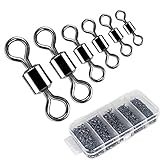 Siasky Fishing Swivels, 200pcs Barrel Swivels Fishing Stainless Steel Swivel FisBarrel swivels for the Carolina rig.
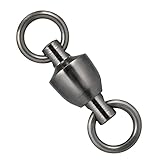 Dr.Fish 20 Pack Ball Bearing Fishing Swivels, Swivels Fishing Tackle Saltwater, Ball bearing swivels, tied on with the Palomar.
 Dr.Fish 30 Pack Fishing 3 Way Swivels, 35-175LB, Three Way Barrel Swivels FishinThree-way swivels for catfish rigs and the dropper loop setup.
 AMYSPORTS Duo Lock Snap Swivels - Stainless Barrel Swivels for Saltwater & FreshSnap swivels for lure changes, see knots for swivels.
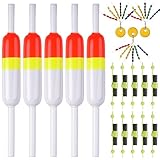 SILANON Fishing Slip Bobbers Kit Fishing Bobbers Floats Balsa Wood Slip Bobbers Slip bobbers for use with the bobber stop knot.
Read next
- Fishing knots by connectionevery knot on Dockrig by job
- Knots for swivelsPalomar, clinch and uni compared
- Bobber stop knotsteps and a depth table
- Knots for braided linewhat holds in braid at a swivel
- Fishing rigswhere each swivel fits in a rig
- Gear we referenceevery product on Dockrig, with the knots and rigs it fits
Sources: maker size and rating labels in each box. Knot steps from the linked knot pages. Method on our methodology page.. Sampo, Rosco barrel swivel chart, for size numbering.