Bobber Stop Knot: Tie a Slip Bobber Stop and Set Your Depth
Dockrig is reader-supported. When you buy through links on this page, we may earn a commission.
A bobber stop knot is a small sliding knot on the main line. The slip bobber rides up the line until it hits the stop. So the distance from stop to hook sets your depth.
Tie it with a short piece of separate line, 4 to 6 turns, uni style. Then add a bead, the bobber, the weight and the hook. For bait 1 ft off the bottom in 10 ft of water, set the stop 9 ft above the hook.
Spec card
Bobber stop knot
- Connects
- a sliding stop on the main line, above a slip bobber
- Stop line
- 6 to 8 in. of stop thread or mono
- Turns
- 4 to 6general practice; more on braid
- Order on the line
- stop, bead, bobber, weight, hook
- Stop to hook
- water depth minus the height off bottom you want
- Don't use for
- a fixed bobber; a stop that won't hold on slick braid with too few turns
The 5 steps
Lay 6 to 8 in. of stop line along the main line. Bend 1 end back to form a loop beside the main line.
Step 1. Lay 6 to 8 in. of stop line along the main line. Tap to enlarge. Wrap that end around the main line and the loop 4 to 6 times. Work from inside the loop.
Step 2. Wrap that end around the main line and the loop 4 to 6 times. Tap to enlarge. Pull both ends of the stop line. The turns close on the main line. Snug, not crushed yet.
Step 3. Pull both ends of the stop line. Tap to enlarge. Slide the stop to your depth, then tighten fully. Trim the tags to about 1/4 in.
Step 4. Slide the stop to your depth, then tighten fully. Tap to enlarge. Thread on a small bead, then the slip bobber. Then tie on the weight and hook below.
Step 5. Thread on a small bead, then the slip bobber. Tap to enlarge.
The stop goes on before the bobber. If you forget, you'll have to cut the hook off and start again.
The bead in step 5 matters. Many stops are small enough to slip into the bobber's line hole. The bead sits between them and stops that.
Leave the tags about 1/4 in. long. They fold flat and pass through the guides when you reel the stop onto the spool. Cut flush, and the knot can pull loose when you move it.
Where to set the stop: depth table
| Water depth | Bait off bottom | Set stop above hook |
|---|---|---|
| 4 ft | 1 ft | 3 ft |
| 6 ft | 1 ft | 5 ft |
| 8 ft | 1 ft | 7 ft |
| 10 ft | 1 ft | 9 ft |
| 12 ft | 1 ft | 11 ft |
| 15 ft | 1 ft | 14 ft |
| 20 ft | 1 ft | 19 ft |
Our assumptions
- Stop to hook = water depth minus the height off bottom you want.
- Bait 1 ft off the bottom. Change that number for fish suspended higher.
- Line hangs straight under the bobber. Wind or current makes it angle, so the bait rides shallower.
Measure stop to hook with your arm span or marks on the rod. Many rods are 6 to 7 ft long, so a 7 ft rod gives an easy reference.
Find the bottom first if you don't know the depth. Clip a heavy weight to the hook and drop it. Slide the stop until the bobber just lies flat on the surface.
Now you know the depth. Move the stop down 1 ft for bait 1 ft off the bottom.
If you'd rather not tie stops, premade slip bobber stops slide onto the line from a small tube. Keep the knot in your kit anyway. It costs nothing and you can tie it on the water.
Stop line: braid vs mono
| Main line | Stop that grips | Notes |
|---|---|---|
| Mono 4 to 12 lb | stop thread or mono, 4 to 5 turns | the easy case |
| Fluoro | stop thread, 5 turns | harder surface; tighten firmly |
| Braid | stop thread, 5 or 6 turns | rubber stops slide more easily on thin braid |
Mono is easy. A stop of thread or mono bites into it and holds.
Braid is thin and slick. A stop that holds on 8 lb mono may creep on 10 lb braid when you cast. Use stop thread and add a turn or 2. Pull it tight.
Rubber stops are fast to put on. On braid, they can slide when the bobber hits them on the cast. We'd use a knotted stop on braid.
Where it fits on the water
- Crappie on brush in 10 to 14 ft: 6 lb mono, #4 light-wire hook, minnow, stop set just above the brush.
- Bluegill on beds in 3 to 5 ft: a small bobber, a split shot and a #8 hook. Stop 2 to 4 ft above the hook.
- Walleye on a rock edge in 15 to 20 ft: leech or crawler, bait 1 to 2 ft off the bottom.
- Catfish off a channel edge: heavier line, a larger bobber, cut bait set near the bottom.
Fish often hold at 1 depth on a given day. When you get a bite, leave the stop where it is.
Matching the bobber to the weight
The bobber has to float the weight, the hook and the bait. Too big, and fish feel it pull back. Too small, and it sinks. That's why a slip bobber kit usually comes with several float sizes.
Many slip bobbers list a weight range on the package. Match your split shot or sinker to it.
If there's no range, test it in a bucket at home with the weights you plan to use. A 1/16 to 1/8 oz bobber is a common panfish size. Walleye and catfish rigs often run heavier.
Add weight until the bobber sits with about 1/2 to 1 in. showing. A bobber riding high goes down slowly on a light bite. One that sits low shows every touch.
Put the weight 12 to 18 in. above the hook. That keeps the bait down near the depth you set, and it lets a minnow swim a bit.
Wind, current and depth
The table assumes the line hangs straight down. On a calm pond, it does.
Wind pushes the bobber across the surface. The line below trails at an angle, and the bait rides shallower than the stop says. Current does the same, often more.
In a breeze, set the stop 1 or 2 ft deeper than the table. Then watch. If you snag the bottom, come back up 1 ft.
A heavier weight helps the line hang straighter. Go up 1 size of split shot and a bobber to match.
Moving the stop
A good stop slides with a firm pull and stays put otherwise. That's the test.
Pinch the stop and slide it. If it won't move, wet it and try again. If it slides on its own when you cast, tighten it or add a turn.
You can move the same stop all day. Replace it if it frays, or if it starts sliding with no push.
Common mistakes
- No bead. The stop slips into the bobber.
- Stop crushed tight before sliding. Then it won't move. Snug, slide, tighten.
- Tags cut flush. The knot loosens over a day of casts.
- Depth guessed, not measured. Find the bottom first.
- Too few turns on braid. Add 1 or 2.
Common Questions
Does a bobber stop go through the rod guides?
Yes, a small knotted stop does. That's why slip bobbers work in deep water. You can reel the stop onto the spool and still cast.
Keep the tags trimmed to about 1/4 in. so they fold flat.
Can you use a uni knot as a bobber stop?
Yes. A uni knot tied with a short piece of line around the main line works. It's the same idea: turns around the main line that slide when you push them.
Bobber stop vs fixed bobber: which one?
A fixed bobber clips onto the line. It's simple in shallow water. Past about 6 ft, the line below gets too long to cast easily. That's where the slip bobber and stop come in.
Gear for this page
 Thill Premium Bobber Stops for Fishing Floats, Fishing Gear and Accessories, 40 Bobber stops for when you'd rather not tie the bobber stop knot.
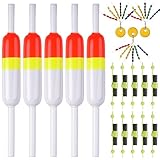 SILANON Fishing Slip Bobbers Kit Fishing Bobbers Floats Balsa Wood Slip Bobbers A slip bobber kit for the bobber stop knot setup.
 SANWEAL 120PCS/ 5 Sizes Removable Split Shot Fishing Weights SinkersSplit shot to weight a slip float below the bobber stop knot.
 XFISHMAN Octopus Hook 3/0 Red - 50 Pack (Reversed Point, Up-Turned Eye)Octopus hooks for slip float rigs under a bobber stop knot.
Next knots
- Fishing knots by connectionevery knot on Dockrig by job
- Swivels and snapsslip bobbers, beads and hardware
- Knots for swivelstying on below the bobber
- Knots for braided linewhy braid needs more turns
- Knot tying toolsclippers for clean tags
Sources: articles_spec outline for steps and stop line. Depth table from dockrig_calc.py. Method on our methodology page.. Cast & Spear, "Bobber Stop Knot," for wraps, tag length and rubber stops.